Products | Xiatra
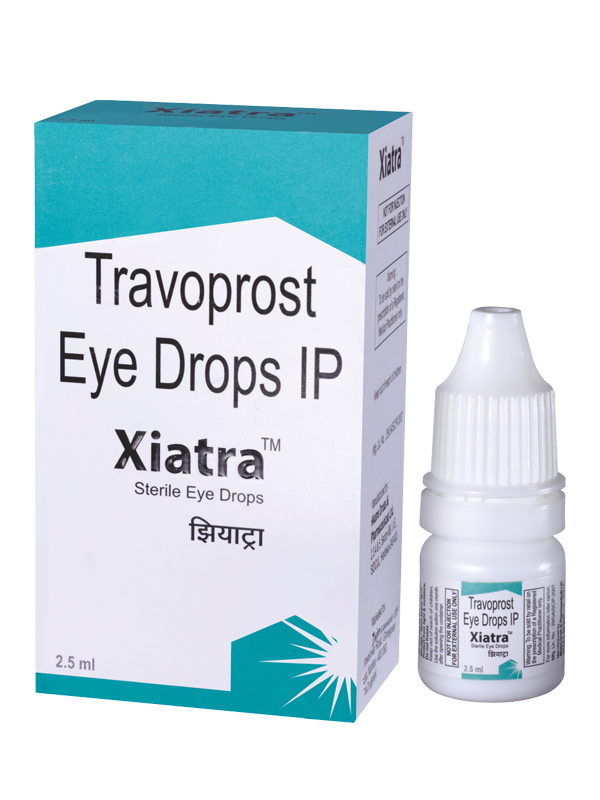
3ML
Xiatra
Travoprost Eye Drops IP
Travoprost is indicated for the reduction of elevated intraocular pressure in patients with open-angle glaucoma or ocular hypertension.
Composition:
Travoprost IP 0.004% w/v
Sterile Aqueous Base q.s.
Pharmaceutical Form:
Eye Drops
Therapeutic Indication:
Travoprost is indicated for the reduction of elevated intraocular pressure in patients with open-angle glaucoma or ocular hypertension.
Application and Administration:
The recommended dosage is one drop in the affected eye(s) once daily in the evening. Travoprost should not be administered more than once daily since it has been shown that more frequent administration of prostaglandin analogs may decrease the intraocular pressure lowering effect.
Reduction of the intraocular pressure starts at approximately 2 hours after the first administration with maximum effect reached after 12 hours.
Travoprost Eye Drops may be used concomitantly with other topical ophthalmic drug products to lower intraocular pressure. If more than one topical ophthalmic drug is being used, the drugs should be administered at least five minutes apart.
Contraindications:
Known hypersensitivity to the active component or any excipients used in the product.
Storage:
Store below 30°C. Protect from light & moisture. Do not freeze.
Gradual change to eyelashes including increased length, thickness and number of lashes can occur, which are usually reversible.
Use with caution in patients with active intraocular inflammation.
Drug Interactions:
There are no known drug interactions. If more than one topical ophthalmic drug is being used, the drugs should be administered with at least five minutes interval between applications.
Pregnancy and Lactation:
There are no adequate studies of Travoprost administration in pregnant women. Hence it should be administered during pregnancy only if the potential benefit justifies the potential risk to the fetus, according to the Physician.
In Nursing Mothers, it is not known whether this drug or its metabolites are excreted in human milk. Because many drugs are excreted in human milk, caution should be exercised when Travoprost is administered to a nursing women.
Adverse Effects:
Most common adverse reaction (30% to 50%) is conjunctival hyperemia. Other adverse effects reported include decreased visual acuity, eye discomfort, foreign body sensation, pain and pruritus.
Pharmacodynamics:
Travoprost is a synthetic prostaglandin F analogue. Since it is a selective FP prostanoid receptor agonist it is believed to reduce intraocular pressure by increasing uveoscleral outflow. The exact mechanism of action is unknown at this time.
Pharmacokinetics:
Travoprost is absorbed through the cornea and is hydrolyzed by esterases in the cornea to the active free acid.
Plasma concentrations of the free acid are below 0.01 ng/ml (the quantitation limit of the assay) in two-thirds of the subjects. In those individuals with quantifiable plasma concentrations, the mean plasma Cmax was 0.018 ± 0.007 ng/ml and was reached within 30 minutes.
Travoprost is estimated to have a plasma half-life of 45 minutes, with no significant accumulation.
The elimination of Travoprost free acid from plasma is rapid and levels are generally below the limit of quantification within one hour after dosing.
Less than 2% of the topical ocular dose of Travoprost was excreted in the urine within 4 hours as the Travoprost free acid.
Presentation:
Xiatra eye drops is available in 3 ml pack.