Products | Lotiviz
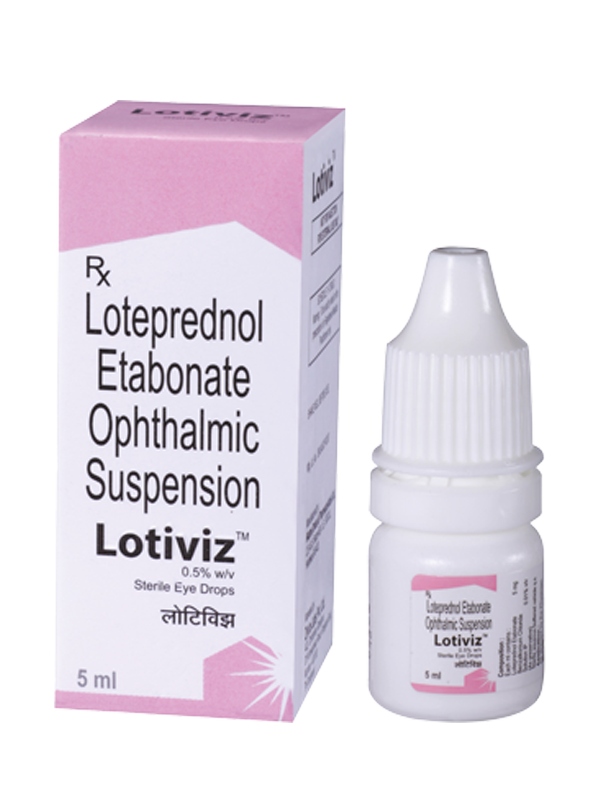
5ML
Lotiviz
Loteprednol Etabonate Ophthalmic Suspension IP
Treatment of steroid responsive inflammatory conditions of the palpebral and bulbar conjunctiva, cornea and anterior segment of the globe.
Composition:
Each ml contains:
Loteprednol Etabonate IP eq. to Loteprednol Etabonate 5 mg (0.5% w/v)
Benzalkonium Chloride Solution IP 0.01% v/v (As preservative)
Sterile Aqueous Base q.s.
Preservative:
Benzalkonium Chloride Solution IP 0.01% v/v is used as preservative.
Therapeutic Class:
Corticosteroid
Indications:
Treatment of steroid responsive inflammatory conditions of the palpebral and bulbar conjunctiva, cornea and anterior segment of the globe such as allergic conjunctivitis, acne rosacea, superficial punctate keratitis, herpes zoster keratitis, iritis, cyclitis. Selected infective conjunctivitis, when the inherent hazard of steroid use is accepted to obtain an advisable diminution in edema and inflammation. Treatment of post-operative inflammation following ocular surgery.
Dosage:
Adults:
Steroid-Responsive Disease: 1-2 drops into the conjunctival sac of the affected eye(s) q.i.d. May increase up to 1 drop q.h., if necessary, during the initial treatment within the 1st week. Re-evaluate if signs/symptoms fail to improve after 2 days.
Postoperative Inflammation: 1-2 drops into the conjunctival sac of the operated eye(s) q.i.d. beginning 24 hrs after surgery and continuing throughout first 2 weeks of the post-operative period.
Application and Administration:
Administration: Ocular route.
Application: As directed by the Physician.
Contraindications:
Most viral diseases of the cornea and conjunctiva (eg, epithelial herpes simplex keratitis [dendritic keratitis], vaccinia, varicella), mycobacterial infection of the eye, and fungal diseases of ocular structures.
Mechanism of Action:
Corticosteroids mechanism of action is not established but they are thought to act by the induction of phospholipase A2 inhibitory proteins, collectively called lipocortins, which control the biosynthesis of potent mediators of inflammation such as prostaglandins and leukotrienes.
Storage:
Store below 30°C. Protect from light & moisture. Do not freeze.
Use the suspension within one month after opening the container.
Keep out of reach of children.
FOR EXTERNAL USE ONLY. NOT FOR INJECTION. SHAKE WELL BEFORE USE.
Adverse Reactions: Abnormal vision/blurring, burning on instillation, chemosis, discharge, dry eyes, epiphora, foreign body sensation, itching, photophobia, headache, rhinitis, pharyngitis.
Patient Counseling: Advise not to allow dropper tip to touch any surface to avoid contamination of the suspension. Instruct to consult physician if pain develops or if redness, itching, or inflammation becomes aggravated. Inform not to wear soft contact lenses during treatment.
For ophthalmic use only. Prolonged use may result in glaucoma with damage to the optic nerve, defects in visual acuity and fields of vision, and in posterior subcapsular cataract formation; caution with glaucoma. Prolonged use may suppress host response and increase hazard of secondary ocular infections. Perforations reported with diseases causing thinning of cornea/sclera. May mask or enhance existing infection in acute purulent conditions of the eye. Caution with history of herpes simplex; may prolong course and exacerbate severity of many viral infections of the eye. May delay healing and increase incidence of bleb formation after cataract surgery.
Initial prescription and renewal of medication order beyond 14 days should only be made after examination of the patient with the aid of magnification (eg, slit lamp biomicroscopy) and, where appropriate, fluorescein staining. Monitor intraocular pressure (IOP) if used for ≥ 10 days. Fungal infections of the cornea may develop coincidentally with long-term use; consider fungal invasion in any persistent corneal ulceration and take fungal cultures when appropriate.
For steroid-responsive diseases, use caution not to discontinue therapy prematurely. Should not be used for acute anterior uveitis in patients who require a more potent corticosteroid.
Pregnancy:
Category C, caution in nursing.
Assessment:
Assess for previous drug hypersensitivity, viral diseases of the cornea and conjunctiva, mycobacterial infection of the eye, fungal diseases of ocular structures, glaucoma, thinning of the cornea/sclera, history of herpes simplex, and pregnancy/nursing status. Perform examination of the patient with the aid of magnification (eg, slit lamp biomicroscopy, fluorescein staining). Assess use in patients who have undergone recent cataract surgery.
Monitoring:
Monitor for glaucoma with damage to the optic nerve, defects in visual acuity and fields of vision, posterior subcapsular cataract formation, perforation of the cornea/sclera, secondary ocular infections, fungal infections, masking of existing infections, and other adverse reactions. Re-evaluate if signs/symptoms fail to improve after 2 days. Monitor IOP during prolonged use (≥ 10 days). Perform examination of the patient with the aid of magnification (eg, slit lamp biomicroscopy, fluorescein staining) before renewal of medication order beyond 14 days.
Presentation:
Lotiviz Eye Drops is available in a 5 ml pack.