Products | Latobest
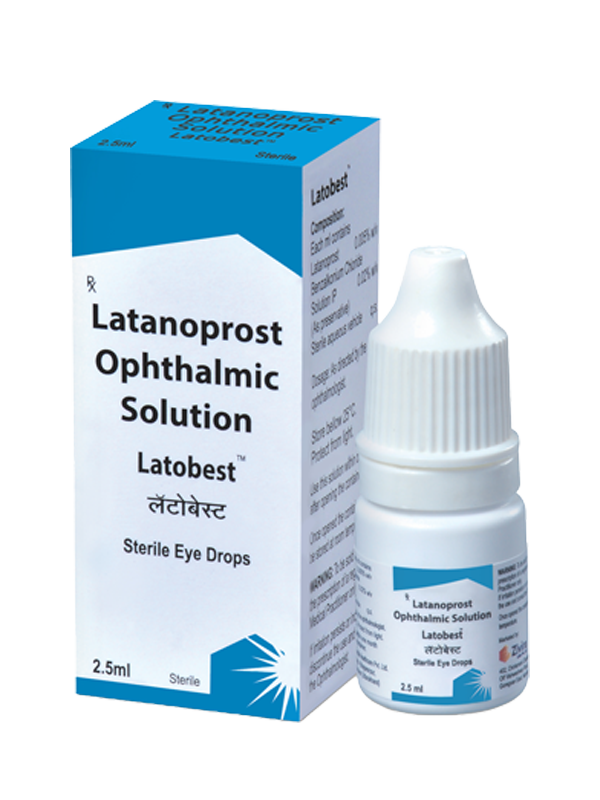
2.5ML
Latobest
Latanoprost Eye Drops IP 0.005% w/v
LATOBEST Eye Drops is indicated for the reduction of elevated intraocular pressure in patients with openangle glaucoma or ocular hypertension.
Description:
Latanoprost is a prostaglandin F2a analogue. Its chemical name is isopropyl-(Z)7[(1 R,2R,3R,5S)3,5-dihydroxy-2-[(3R)-3-hydroxy-5-phenylpentyl]cyclopentyl]-5-heptenoate. Its molecular formula is C26H40O5 and its chemical structure is as depicted on the pack insert (M.W. 432.58).
Latanoprost is a colorless to slightly yellow oil that is very soluble in acetonitrile and freely soluble in acetone, ethanol, ethyl acetate, isopropanol, methanol, and octanol. It is practically insoluble in water.
LATOBEST Eye Drops (Latanoprost) is supplied as a sterile, isotonic, buffered aqueous solution of latanoprost with a pH of approximately 6.7 and an osmolality of approximately 267 mOsmol/kg. Each ml of LATOBEST contains 50 micrograms of latanoprost. Benzalkonium chloride, 0.02% is added as a preservative. The inactive ingredients are: sodium chloride, sodium dihydrogen phosphate monohydrate, disodium hydrogen phosphate anhydrous, and water for injection. One drop contains approximately 1.5 µg of latanoprost.
Mechanism of Action:
Latanoprost is a prostanoid selective FP receptor agonist that is believed to reduce the intraocular pressure (IOP) by increasing the outflow of aqueous humor. Studies in animals and man suggest that the main mechanism of action is increased uveoscleral outflow. Elevated IOP represents a major risk factor for glaucomatous field loss. The higher the level of IOP, the greater the likelihood of optic nerve damage and visual field loss.
Indications:
LATOBEST Eye Drops is indicated for the reduction of elevated intraocular pressure in patients with openangle glaucoma or ocular hypertension.
Dosage and Administration:
The recommended dosage is one drop (1.5 µg) in the affected eye(s) once daily in the evening. If one dose is missed, treatment should continue with the next dose as normal. The dosage of LATOBEST Eye Drops should not exceed once daily; the combined use of two or more prostaglandins, or prostaglandin analogs including LATOBEST Eye Drops is not recommended. It has been shown that administration of these prostaglandin drug products more than once daily may decrease the intraocular pressure lowering effect or cause paradoxical elevations in IOP. Reduction of the intraocular pressure starts approximately 3 to 4 hours after administration and the maximum effect is reached after 8 to 12 hours. LATOBEST may be used concomitantly with other topical ophthalmic drug products to lower intraocular pressure. If more than one topical ophthalmic drug is being used, the drugs should be administered at least five (5) minutes apart.
How to Store LATOBEST:
Keep out of the reach and sight of children.
Do not use LATOBEST after the expiry date which is stated on the carton and bottle. The expiry date refers to the last day of that month. Store the unopened bottle at room temperature (below 25°C), protected from light. After opening the bottle store it at room temperature (below 25°C) and use within 4 weeks of opening. When you are not using LATOBEST, keep the bottle in the outer carton, in order to protect it from light. Medicines should not be disposed of via wastewater or household waste. Ask your pharmacist how to dispose of medicines no longer required. These measures will help to protect the environment.
Possible side effects
Like all medicines, LATOBEST can cause side effects, although not everybody gets them. The following are known side effects of using LATOBEST:
Very common (likely to affect more than 1 in 10 people):
A gradual change in your eye colour by increasing the amount of brown pigment in the coloured part of the eye known as the iris. If you have mixed-colour eyes (blue-brown, grey-brown, yellow-brown or green-brown) you are more likely to see this change than if you have eyes of one colour (blue, grey, green or brown eyes). Any changes in your eye colour may take years to develop although it is normally seen within 8 months of treatment. The colour change may be permanent and may be more noticeable if you use LATOBEST in only one eye. There appears to be no problems associated with the change in eye colour. The eye colour change does not continue after LATOBEST treatment is stopped.
Redness of the eye.
Eye irritation (a feeling of burning, grittiness, itching, stinging or the sensation of a foreign body in the eye).
A gradual change to eyelashes of the treated eye and the fine hairs around the treated eye, seen mostly in people of Japanese origin. These changes involve an increase of the colour (darkening), length, thickness and number of your eye lashes.
Common (likely to affect less than 1 in 10 people):
Irritation or disruption to the surface of the eye, eyelid inflammation (blepharitis), eye pain and light sensitivity (photophobia).
Uncommon (likely to affect less than 1 in every 100 people):
Eyelid swelling, dryness of the eye, inflammation or irritation of the surface of the eye (keratitis), blurred vision and conjunctivitis.
Skin rash.
Rare (likely to affect less than 1 in every 1000 people):
Inflammation of the iris, the coloured part of the eye (iritis/uveitis); swelling of the retina (macular oedema), symptoms of swelling or scratching/damage to the surface of the eye, swelling around the eye (periorbital oedema) misdirected eyelashes or an extra row of eyelashes.
Skin reactions on the eyelids, darkening of the skin of the eyelids.
Asthma, worsening of asthma and shortness of breath (dyspnoea).
Very rare (likely to affect less than 1 in 10,000 people):
Worsening of angina in patients who also have heart disease, chest pain, sunken eye appearance (eye sulcus deepening). Patients have also reported the following side-effects: fluid filled area within the coloured part of the eye (iris cyst), headache, dizziness, awareness of heart rhythm (palpitations), muscle pain, joint pain and developing a viral infection of the eye caused by the herpes simplex virus (HSV). Side effects seen more often in children compared to adults are runny itchy nose and fever.
In very rare cases, some patients with severe damage to the clear layer at the front of the eye (the cornea) have developed cloudy patches on the cornea due to calcium build-up during treatment.
Reporting of side effects
If you get any side effects talk to your doctor, pharmacist or nurse. This includes any possible side effect not listed in this leaflet.
By reporting side effects you can help provide more information on the safety of this medicine.
Pharmacokinetics/Pharmacodynamics:
Absorption
Latanoprost is absorbed through the cornea where the isopropyl ester prodrug is hydrolyzed to the acid form to become biologically active. Studies in man indicate that the peak concentration in the aqueous humor is reached about two hours after topical administration.
Distribution
The distribution volume in humans is 0.16 ± 0.02 L/kg. The acid of latanoprost can be measured in aqueous humor during the first 4 hours, and in plasma only during the first hour after local administration.
Metabolism
Latanoprost, an isopropyl ester prodrug, is hydrolyzed by esterases in the cornea to the biologically active acid. The active acid of latanoprost reaching the systemic circulation is primarily metabolized by the liver to the 1,2-dinor and 1,2,3,4-tetranor metabolites via fatty acid β-oxidation.
Excretion
The elimination of the acid of latanoprost from human plasma is rapid (t1/2 = 17 min) after both intravenous and topical administration. Systemic clearance is approximately 7 ml/min/kg. Following hepatic β-oxidation, the metabolites are mainly eliminated via the kidneys. Approximately 88% and 98% of the administered dose are recovered in the urine after topical and intravenous dosing, respectively.
Animal Studies:
In monkeys, latanoprost has been shown to induce increased pigmentation of the iris. The mechanism of increased pigmentation seems to be stimulation of melanin production in melanocytes of the iris, with no proliferative changes observed.
The change in iris color may be permanent.
Ocular administration of latanoprost at a dose of 6µg/eye/day (4 times the daily human dose) to cynomolgus monkeys has also been shown to induce increased palpebral fissure. This effect was reversible upon discontinuation of the drug.
Further Information:
What LATOBEST contains
The active substance is 0.005% (50 micrograms/ml) latanoprost.
The other ingredients are: benzalkonium chloride, sodium chloride, sodium dihydrogen phosphate monohydrate (E339a) and anhydrous disodium phosphate (E339b) dissolved in water for injections.