Products | Britivin
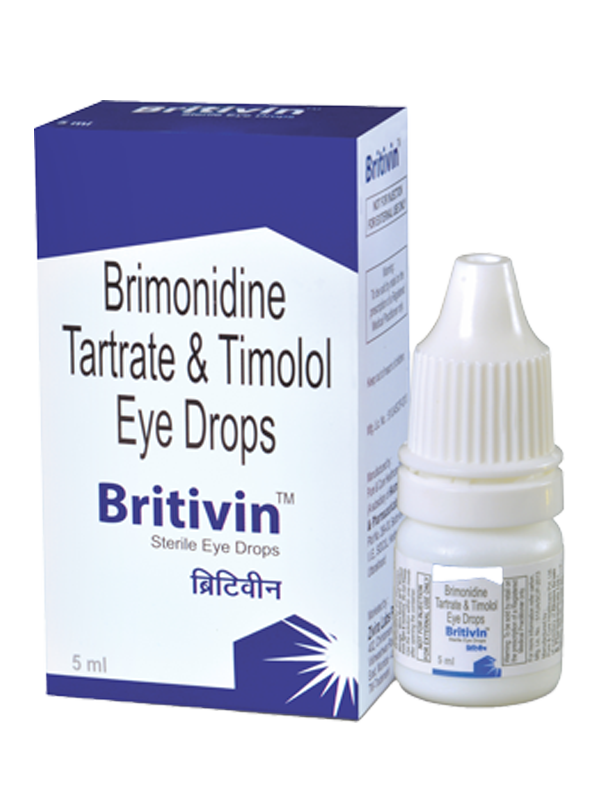
5ML
Britivin
Brimonidine Tartrate and Timolol Maleate Ophthalmic Solution
Brimonidine Tartrate and Timolol Maleate Ophthalmic Solution is indicated in the reduction of Intraocular Pressure (IOP) in patients with chronic open-angle glaucoma or ocular hypertension who are insufficiently responsive to topical beta-blockers.
Composition:
Brimonidine Tartrate 0.15% w/v
Timolol Maleate IP
equivalent to Timolol 0.5% w/v
Stabilized Oxychloro Complex 0.005% w/v
(As preservative)
Sterile Aqueous Base q.s.
Indications:
Brimonidine Tartrate and Timolol Maleate Ophthalmic Solution is indicated in the reduction of Intraocular Pressure (IOP) in patients with chronic open-angle glaucoma or ocular hypertension who are insufficiently responsive to topical beta-blockers.
Contraindications:
Brimonidine Tartrate and Timolol Maleate Ophthalmic Solution is hypersensitivity to the active substances or to any of the excipients.
Reactive airway disease including bronchial asthma or a history of bronchial asthma, severe chronic obstructive pulmonary disease.
Sinus bradycardia, sick sinus syndrome sino-atrial block, second or third degree atrioventricular block not controlled with a pace-maker, overt cardiac failure, cardiogenic shock.
Use in neonates and infants (less than 2 years of age).
Patients receiving monoamine oxidase (MAO) inhibitor therapy.
Patients on antidepressants which affect noradrenergic transmission (e.g. tricyclic antidepressants and mianserin).
Storage:
Store below 30°C. Protect from light & moisture. Do not freeze.
No enhancement of the systemic absorption of the individual active substances has been observed.
Due to beta-adrenergic component, timolol, the same types of cardiovascular, pulmonary and other adverse reactions seen with systemic beta-adrenergic blocking agents may occur.
Incidence of systemic ADRs after topical ophthalmic administration is lower than for systemic administration.
Drug Interactions:
No interaction studies have been performed with the Brimonidine & Timolol fixed combination.
Although specific drug interactions studies have not been conducted with Brimonidine Tartrate and Timolol Maleate Ophthalmic Solution, the theoretical possibility of an additive or potentiating effect with CNS depressants (alcohol, barbiturates, opiates, sedatives, or anaesthetics) should be considered.
Mydriasis resulting from concomitant use of ophthalmic beta-blockers and adrenaline (epinephrine) has been reported occasionally.
Beta-blockers may increase the hypoglycaemic effect of antidiabetic agents. Beta-blockers can mask the signs and symptoms of hypoglycaemia.
Although specific drug interactions studies have not been conducted with Brimonidine Tartrate and Timolol Maleate Ophthalmic Solution, the theoretical possibility of an additive IOP lowering effect with prostamides, prostaglandins, carbonic anhydrase inhibitors and pilocarpine should be considered.
Pregnancy:
Pregnancy Category C:
There are no adequate data for the use of the Brimonidine & Timolol fixed combination in pregnant women. Brimonidine Tartrate and Timolol Maleate Ophthalmic Solution should not be used during pregnancy unless clearly necessary.
Nursing Mothers:
It is not known if brimonidine is excreted in human milk but it is excreted in the milk of the lactating rat.
Beta-blockers are excreted in breast milk. However, at therapeutic doses of timolol in eye drops it is not likely that sufficient amounts would be present in breast milk to produce clinical symptoms of beta-blockade in the infant.
Brimonidine Tartrate and Timolol Maleate Ophthalmic Solution should not be used by women breast-feeding infant.
Pediatric Use:
The safety and effectiveness of Brimonidine Tartrate and Timolol Maleate Ophthalmic Solution in children and adolescents (2 to 17 years of age) have not been established and therefore, its use is not recommended in children or adolescents.
Geriatric Use:
No overall differences in safety or effectiveness have been observed between elderly and younger patients.
Symptoms and Treatment of Overdosage:
Rare reports of overdosage with Brimonidine Tartrate and Timolol Maleate Ophthalmic Solution in humans resulted in no adverse outcome.
Treatment of an overdose includes supportive and symptomatic therapy; a patient's airway should be maintained.
Ophthalmic overdose (Adults):
In those cases received, the events reported have generally been those already listed as adverse reactions.
Systemic overdose resulting from accidental ingestion (Adults):
There is very limited information regarding accidental ingestion of brimonidine in adults. The only adverse event reported to date was hypotension. It was reported that the hypotensive episode was followed by rebound hypertension.
Oral overdoses of other alpha-2-agonists have been reported to cause symptoms such as hypotension, asthenia, vomiting, lethargy, sedation, bradycardia, arrhythmias, miosis, apnoea, hypotonia, hypothermia, respiratory depression and seizure.
Paediatric population:
Symptoms of systemic timolol overdose include: bradycardia, hypotension, bronchospasm, headache, dizziness and cardiac arrest. A study of patients showed that timolol did not dialyse readily.
Dosage and Administration:
To avoid contamination of the eye or eye drops do not allow the dropper tip to come into contact with any surface.
Recommended dosage in adults (including the elderly):
The recommended dose is one drop of Brimonidine Tartrate and Timolol Maleate Ophthalmic Solution in the affected eye(s) twice daily, approximately 12 hours apart.
If more than one topical ophthalmic product is to be used, the different products should be instilled at least 5 minutes apart.
Special Instructions:
Patients should be advised to avoid contamination of the dispensing tip.
Presentation:
Britivin Eye Drops are available in 5ml sterile plastic bottles.